
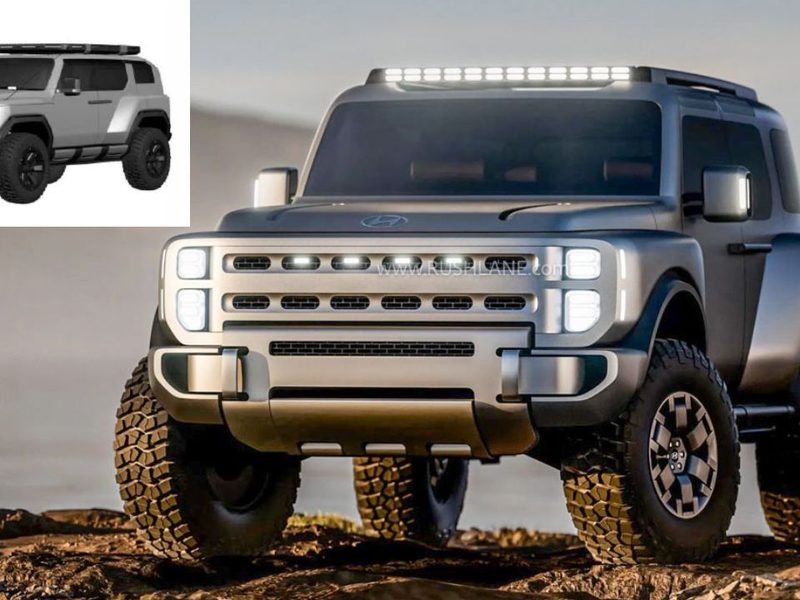
Hyundai has quietly filed a design patent for the Boulder SUV in India, a significant move that suggests the Korean carmaker is seriously considering bringing its off-road-focused concept to the domestic market. The patent application reveals a design that stays remarkably close to the Boulder concept unveiled globally in April 2026, though with refinements tailored for Indian regulations and buyer preferences.
What is the Hyundai Boulder SUV India patent filing?
The Hyundai Boulder SUV India design patent marks the company’s first formal step toward launching a dedicated off-road vehicle in a segment currently dominated by the Mahindra Thar. Unlike Hyundai’s existing SUV lineup—which focuses on urban crossovers like the Creta and Venue—the Boulder represents a completely different philosophy: rugged, body-on-frame construction built for genuine terrain capability rather than lifestyle appeal.
Patent filings in India typically precede production-ready launches by 18–36 months, though they don’t guarantee a vehicle will eventually reach showrooms. That said, Hyundai’s decision to patent the design locally rather than simply importing global intellectual property suggests internal confidence about market viability. The company has been gradually expanding its SUV portfolio and clearly sees an opening in the hardcore off-road space.
Design and platform details of the Boulder
The Hyundai Boulder SUV India patent shows a boxy, angular silhouette that owes more to utilitarian 4×4 philosophy than modern crossover trends. The design features a pronounced horizontal grille, upright windscreen, flat bonnet, and squared-off body sides—all hallmarks of true body-on-frame construction. Ground clearance appears substantial, and the patent drawings hint at protective cladding around the wheel arches and lower body, signalling serious off-road intent.
Unlike the Creta or Venue, which sit on monocoque platforms optimized for comfort and efficiency, the Boulder’s body-on-frame architecture allows for genuine four-wheel-drive capability, higher departure and approach angles, and the kind of durability needed for rough terrain. This is the same structural philosophy that makes the Thar so capable—and so popular with buyers who actually venture off tarmac.
The patent filing doesn’t reveal engine options or final dimensions, but the global concept hints at a mid-size positioning, likely somewhere between the Thar and larger 7-seater SUVs. Interior space, payload capacity, and approach angles will be critical to its competitiveness against the Thar, which has become the gold standard for affordable, capable off-roaders in India.
Hyundai Boulder SUV India: timing and market positioning
The timing of this patent is intriguing. Mahindra’s Thar has enjoyed near-monopoly status in the affordable rugged SUV segment since its 2020 relaunch, with waiting periods often stretching beyond a year. Buyers wanting genuine 4×4 capability at a reasonable price have had few alternatives—the Maruti Jimny is more niche and expensive, while used Fortuners dominate the upper end.
Hyundai’s entry would disrupt this comfortable duopoly. The Korean brand has proven its ability to undercut established rivals on price while maintaining quality—the Creta’s success against the Seltos and XUV500 demonstrates this pattern. A competitively priced Hyundai Boulder SUV India offering could siphon significant sales from the Thar, especially if it matches capability at a lower on-road price or offers better warranty and service support.
That said, brand perception matters. Hyundai is seen as an urban, lifestyle-oriented brand in India. Convincing buyers that a Hyundai can be as tough and capable as a Mahindra Thar will require more than engineering—it demands marketing, dealer presence in Tier-2 towns and rural areas, and proven real-world performance stories.
Rivals and competitive landscape
If the Hyundai Boulder SUV India reaches production, it will face a surprisingly limited but well-entrenched competitor set. The Mahindra Thar remains the segment leader, with prices starting around ₹9.5–10 lakh ex-showroom and waiting periods that sometimes exceed 12 months. The Maruti Jimny occupies a smaller, premium niche at ₹12–15 lakh. Beyond that, buyers typically jump to used vehicles or larger SUVs.
The Boulder’s success will hinge on three factors: price (undercutting the Thar by ₹1–2 lakh would be aggressive but not unprecedented for Hyundai), capability (matching or exceeding the Thar’s off-road credentials), and brand trust (proving reliability and after-sales support in smaller towns). Hyundai’s extensive dealer network is an advantage here—many Tier-2 towns have Hyundai service centers where Thar buyers might struggle to find authorized support.
Engine and powertrain possibilities
The global Boulder concept has been shown with petrol and diesel options, though specifics remain vague. For the Indian market, a 2.0-liter diesel engine producing around 170 bhp would make sense—enough to compete with the Thar’s 110 bhp diesel while remaining efficient for long-distance touring. A petrol option, possibly a 1.6-liter turbo, would appeal to buyers in metro cities and those prioritizing lower running costs.
Manual and automatic transmissions are both likely, with the manual being crucial for off-road credibility and the automatic targeting urban buyers. Four-wheel drive would be standard or available depending on the variant strategy.
What this patent means for buyers
For someone currently waiting 8–12 months for a Thar, the prospect of a Hyundai Boulder SUV India alternative is genuinely exciting. Competition typically forces price cuts and faster delivery timelines—both of which benefit buyers. If Hyundai can deliver a capable, affordable off-roader backed by strong warranty and service, it changes the game for the segment.
However, patience is warranted. Patent filings are not launch confirmations. Hyundai may decide the market is too small, or that the investment doesn’t justify the return. Even if development proceeds, a production version won’t reach showrooms before late 2027 or 2028 at the earliest.
The bottom line
The Hyundai Boulder SUV India patent filing is a genuine signal, not mere speculation. It tells us that Hyundai is serious about the off-road segment and sees room for a credible challenger to the Thar. Whether that translates into an actual launch depends on internal business cases and how the market evolves over the next two years. If it does happen, expect a fiercely competitive product that finally gives Thar buyers a real alternative. If it doesn’t, the Thar’s reign as India’s off-road SUV king remains unchallenged—for now.
Frequently asked questions
Is the Hyundai Boulder SUV India confirmed for launch?
Not yet. The design patent filing is a strong signal of intent, but Hyundai has made no official announcement. Patents typically precede launches by 18–36 months, so a 2027–2028 arrival is possible if development proceeds.
How will the Hyundai Boulder SUV India compete against the Mahindra Thar?
The Boulder would likely undercut the Thar on price while matching its off-road capability through body-on-frame construction and 4×4 drivetrain. Hyundai’s stronger urban dealer network could also be an advantage for warranty and service.
What engine options might the Hyundai Boulder SUV India have?
A 2.0-liter diesel (around 170 bhp) and a 1.6-liter petrol turbo are likely, with manual and automatic transmissions. Exact specs remain unconfirmed until an official reveal.