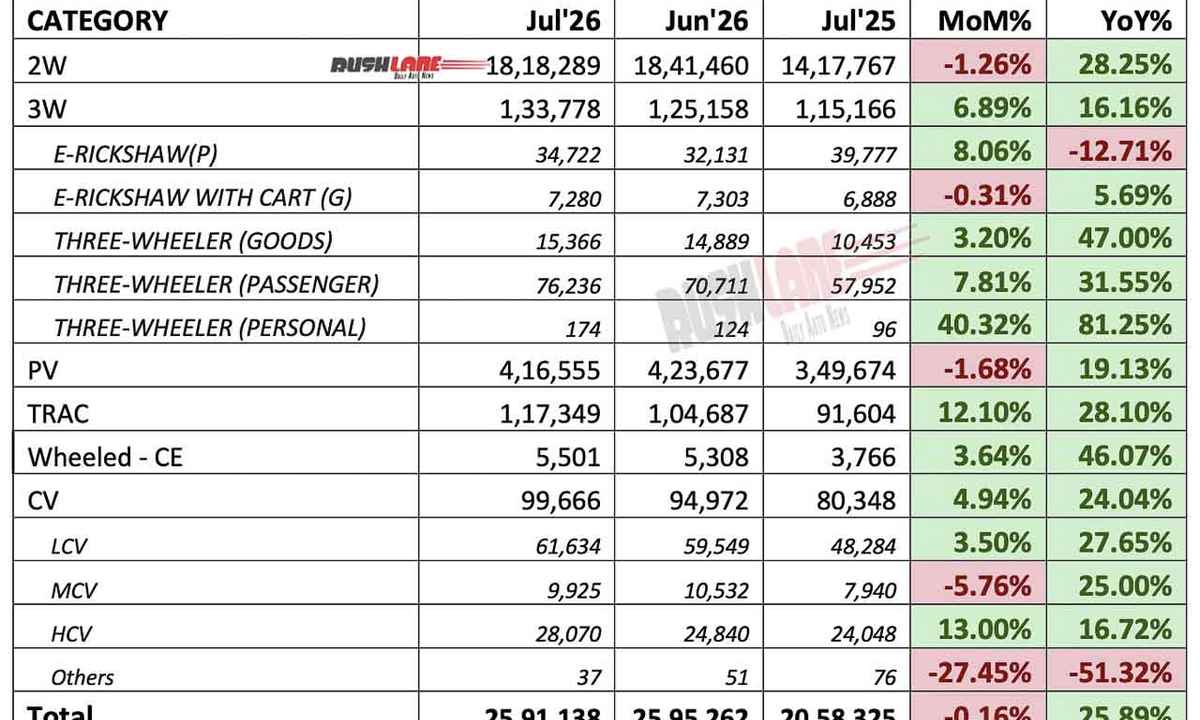
For the first time ever, Indian car sales in July 2026 breached the 4 lakh unit barrier. Passenger vehicle retail registrations hit a fresh all-time high for the month, signalling a market that’s finally breaking through seasonal constraints that have historically kept July sales muted. The broader auto retail sector also posted record numbers, underlining strong consumer demand across the country.
Indian car sales July 2026: The milestone explained
Crossing 4 lakh units in a single month is no small feat for the Indian automotive industry. July has traditionally been a softer month — the monsoon season disrupts supply chains, dealership footfall dips, and buyers often defer purchases to the festive season later in the year. That Indian car sales July 2026 shattered this pattern suggests something structural has shifted in buyer behaviour or market capacity.
The 4 lakh milestone reflects cumulative retail registrations across all manufacturers — from mass-market players like Maruti Suzuki down to ultra-premium brands. This isn’t wholesale numbers (which dealers report to companies); these are actual on-road registrations, making them a more reliable barometer of genuine customer demand. Hit this threshold in July, traditionally the weakest month, and you’re looking at a market firing on all cylinders.
Who drove the surge in Indian car sales July 2026
Maruti Suzuki, as always, anchors the volume story. The company’s dominance in entry-level hatchbacks and compact sedans means it captures roughly 40% of the overall pie — so when Indian car sales July 2026 spike, Maruti’s numbers spike hardest. Tata Motors and Mahindra, both riding strong SUV demand, posted healthy numbers too. Hyundai continues to chip away at the mid-segment with models like the Creta and i20, while Toyota and Kia are slowly expanding their footprint.
The luxury segment — BMW, Mercedes-Benz — also contributed to the record, though their absolute volumes remain modest. What matters is that across every price point, from ₹5 lakh hatchbacks to ₹1+ crore luxury sedans, buyers were active in July. That breadth is unusual for the month and speaks to strong underlying sentiment.
What’s driving the momentum
Several factors are likely at play. First, the economy appears resilient — corporate hiring remains steady, and urban employment in metros and Tier-2 towns is holding up. Second, inventory levels at dealerships are healthy, meaning buyers aren’t facing long waiting periods on popular models. Third, financing options remain accessible; banks and NBFCs are still competitive on interest rates, making EMIs manageable even as vehicle prices have climbed.
There’s also the SUV effect. The Indian market has decisively shifted toward SUVs and crossovers, away from sedans and hatchbacks. Since margins on SUVs are fatter and buyers are willing to stretch budgets for them, manufacturers have ramped production. Tata’s Nexon, Mahindra’s XUV700, Hyundai’s Creta, and Maruti’s new compact SUVs are all selling briskly. When the portfolio skews toward higher-value vehicles, unit sales can climb even as transaction values rise.
Overall auto retail registrations also hit new July high
The passenger vehicle segment wasn’t alone in posting records. Total auto retail registrations — which include two-wheelers, commercial vehicles, tractors, and three-wheelers — also hit a fresh July peak. This suggests the strength isn’t confined to cars alone. Two-wheeler sales, which dwarf four-wheeler numbers in absolute terms, likely drove a chunk of the overall growth. But the fact that commercial vehicles and tractors also posted decent numbers hints at rural demand picking up, possibly ahead of the monsoon harvest.
What this means for the rest of 2026
If July — historically a weak month — can deliver 4 lakh passenger vehicle units and record total auto retail, then August and September should be strong too. The real test comes in October-November, when the festive season kicks in. That’s when buyers typically make big-ticket purchases, and if the market maintains momentum, full-year numbers could exceed 40 lakh units for the first time.
For dealers, this is a golden run. Waiting periods on popular models like the Creta, Nexon, and Maruti Swift remain stretched, and inventory turnover is fast. For manufacturers, the challenge shifts from demand generation to supply chain execution — ensuring factories can keep pace without stockouts. For buyers, the silver lining is limited: strong demand means less negotiating room on prices, though availability is improving compared to earlier years.
The catch: Is it sustainable?
Here’s where caution is warranted. A single strong month, even a historic one, doesn’t guarantee a sustained uptrend. If monsoon disruptions hit supply chains harder in August, or if rural cash flow tightens, July could look like a blip. Fuel prices remain volatile, and any sharp spike in petrol or diesel could dampen buyer sentiment, especially in the entry-level segment where price sensitivity is acute.
Additionally, interest rates are a wild card. If the RBI tightens monetary policy in the second half of 2026, EMI costs will rise, and first-time buyers in the ₹5–10 lakh range may defer purchases. That would hurt Maruti and Hyundai more than premium players.
The bottom line
Indian car sales July 2026 crossing 4 lakh units is genuinely noteworthy — it breaks a seasonal pattern that’s held for years. But one month doesn’t make a trend. The market has shown it can deliver volume when conditions align: healthy employment, low waiting periods, a strong SUV portfolio, and accessible finance. The question now is whether this is the new normal or a temporary surge. Come August and the festive season, we’ll have a clearer picture. For now, celebrate the milestone, but don’t assume July’s magic repeats every month.
Frequently asked questions
Why is Indian car sales July 2026 crossing 4 lakh units significant?
July has historically been the weakest month for car sales due to monsoon disruptions and lower buyer activity. Breaking 4 lakh units in July—typically 15-20% below peak months—signals structural strength in the market and suggests strong underlying demand across price segments.
Which brands contributed most to Indian car sales July 2026?
Maruti Suzuki leads with roughly 40% market share, followed by Tata Motors and Mahindra (riding SUV demand), and Hyundai. Luxury brands like BMW and Mercedes also posted gains, indicating strength across all price points.
Will Indian car sales July 2026 momentum continue into August and beyond?
It depends on supply chain stability, monsoon impact, and interest rate moves. While the July surge is encouraging, rising fuel costs or RBI rate hikes could dampen buyer sentiment, especially in the budget segment. The festive season (Oct-Nov) will be the real test.