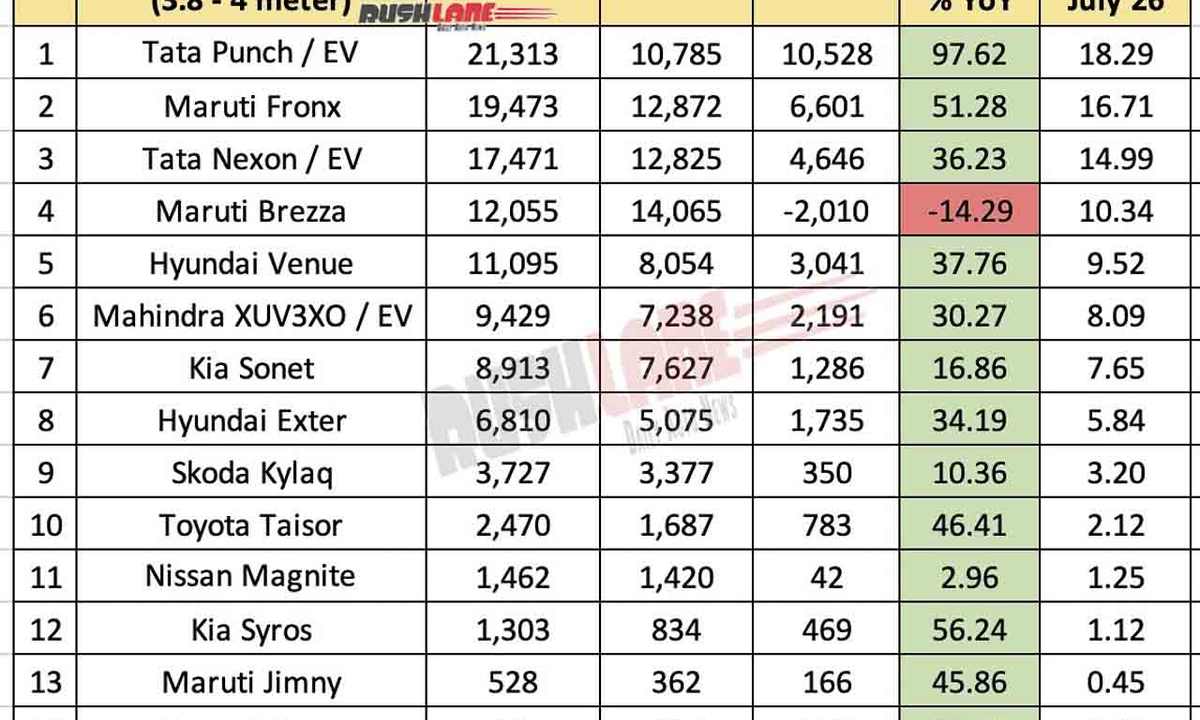
India’s compact SUV segment is on fire. In July 2026, the sub-4 metre SUV category moved a staggering 1,16,552 units—and the compact SUV sales July 2026 numbers reveal just how dominant this space has become in the Indian passenger vehicle market. For buyers caught between the affordability of hatchbacks and the practicality demands of a proper SUV, this segment has become the default choice.
The Tata Punch stormed to the top of the charts, outpacing rivals including the Maruti Suzuki Fronx and its corporate sibling, the Tata Nexon. This isn’t a squeaky-close race either—the Punch’s commanding performance underscores a shift in how Indian buyers are thinking about their next vehicle purchase.
Compact SUV sales July 2026: The big picture
What makes compact SUV sales July 2026 so striking is the sheer volume. Over 1.16 lakh units in a single month tells you everything about where the Indian car market’s centre of gravity has shifted. This segment has evolved from a niche offering into the mainstream. Five years ago, the compact SUV was still fighting for legitimacy against the traditional sedan. Today, it’s the segment everyone’s fighting to own.
The sub-4 metre constraint—a regulatory quirk born from India’s tax structure—has paradoxically become a strength. Manufacturers have learned to squeeze genuine SUV capability, practicality, and style into a footprint that keeps prices accessible. The result: a category that appeals to first-time SUV buyers, young professionals in metro cities, and Tier-2 town buyers looking for value and presence.
Who’s winning: Punch leads the pack
The Tata Punch’s ascent to the top spot isn’t accidental. Launched to fill the gap between the Tata Nexon and Tata Altroz, the Punch has carved out its own identity—affordable, practical, and increasingly feature-rich. Its compact dimensions make it a breeze to manoeuvre in congested urban spaces, while the raised driving position and SUV stance appeal to buyers who want the look without the bulk.
Behind the Punch, the Maruti Suzuki Fronx holds steady in second place. Maruti’s distribution network and brand trust continue to work in its favour, even as the Fronx battles against a rising tide of newer competitors. The Nexon, despite being the older player and a proven workhorse, finds itself in third place—a position that likely concerns Tata, given the Nexon’s historical dominance in the compact SUV segment.
The top 10 compact SUV sales July 2026 roster also includes familiar names: the Hyundai Venue, Mahindra XUV 3XO, Kia Sonet, Mahindra XUV 3XO, and the newly launched Mahindra Kylaq. Each occupies a distinct position in the market, catering to different buyer priorities—whether that’s features, reliability, resale value, or pricing.
What’s driving this boom?
Several factors are colliding to create this perfect storm for compact SUVs. First, the festive season build-up begins in July—dealers stock aggressively, and buyers start their research for the peak buying months ahead. Second, manufacturers have loaded these vehicles with features that were once reserved for segment above: touchscreen infotainment, wireless charging, panoramic sunroofs, and advanced safety kit. At ₹5–7 lakh ex-showroom, buyers feel they’re getting genuine value.
Third, there’s the psychological factor. The compact SUV offers a sense of occasion—you’re not buying a hatchback, even though the dimensions might suggest otherwise. That perception of upward mobility resonates deeply with Indian buyers, particularly in aspirational markets outside the metros.
Finally, the competition itself is fuelling growth. With manufacturers constantly refreshing models and launching new variants, there’s something for every budget and preference. The Kylaq’s recent entry has energised the segment by offering fresh styling and a compelling value proposition at the entry level.
The catch: Inventory and waiting periods
Here’s where the picture gets complicated. With compact SUV sales July 2026 hitting these stratospheric numbers, inventory management has become a real headache. Popular variants of the Punch and Nexon are seeing waiting periods stretch into months in major metros. If you’re shopping right now, expect to either book well ahead or compromise on your preferred colour and trim.
Resale values, meanwhile, remain strong. The segment’s popularity means there’s always a buyer for a well-maintained used compact SUV. This works in your favour if you’re planning to upgrade in three to four years.
Rivals to watch
| Model | Key Strength | Price Range (approx) | Best For |
|---|---|---|---|
| Tata Punch | Affordability + practicality | ₹5.49–7.49 lakh | Budget-conscious first-time SUV buyers |
| Maruti Fronx | Brand trust + service network | ₹5.99–9.49 lakh | Buyers prioritising reliability |
| Tata Nexon | Proven performance + features | ₹6.99–11.99 lakh | Those wanting a feature-rich, spacious cabin |
| Hyundai Venue | Design + warranty | ₹6.49–10.99 lakh | Style-conscious buyers |
| Mahindra Kylaq | Fresh design + value | ₹5.99–9.49 lakh | New car seekers wanting latest styling |
The bottom line
The compact SUV sales July 2026 figures aren’t just a monthly blip—they signal a fundamental shift in Indian buyer preferences. The segment has matured, diversified, and become genuinely competitive. For buyers, this is good news: choice, features, and competitive pricing. For manufacturers, it’s a crowded battlefield where differentiation is harder than ever.
If you’re in the market for a compact SUV, now is both the best and worst time to buy. Best because the selection and features are unmatched. Worst because waiting periods are brutal and inventory is tight. Our advice: decide on your non-negotiables (budget, fuel type, key features), book early, and be prepared to wait. The segment isn’t slowing down anytime soon.
Frequently asked questions
Why is the Tata Punch leading compact SUV sales July 2026?
The Punch combines affordability (starting under ₹5.5 lakh), practical dimensions, and increasing feature content. Its entry-level positioning and Tata’s improving after-sales network have made it the go-to choice for first-time SUV buyers across metros and Tier-2 towns.
What’s the difference between a compact SUV and a regular SUV?
Compact SUVs are under 4 metres in length to qualify for lower tax brackets in India. They sacrifice some interior space and boot capacity compared to larger SUVs, but offer better manoeuvrability, lower running costs, and more affordable pricing.
Should I wait for a specific model or buy now?
If you have a specific model in mind, book immediately—waiting periods are 2–4 months for popular variants. If you’re flexible, the current compact SUV sales July 2026 boom means excellent inventory across brands, so you have genuine choice in colour, trim, and powertrain.